
Can You Roll Over a 457(b) Plan to an IRA?
Yes, you can roll over many 457(b) plans to an IRA, but whether it is allowed and how it is taxed depends entirely on the type of 457(b) plan you have and how the rollover is executed. Understanding these distinctions is critical, because the wrong move can trigger unnecessary taxes, lost benefits, or even penalties later on.
This guide explains how 457(b) rollovers work, the difference between governmental and non-governmental plans, how to avoid taxes during the transfer, and the key tradeoffs you should consider before moving money into an IRA.
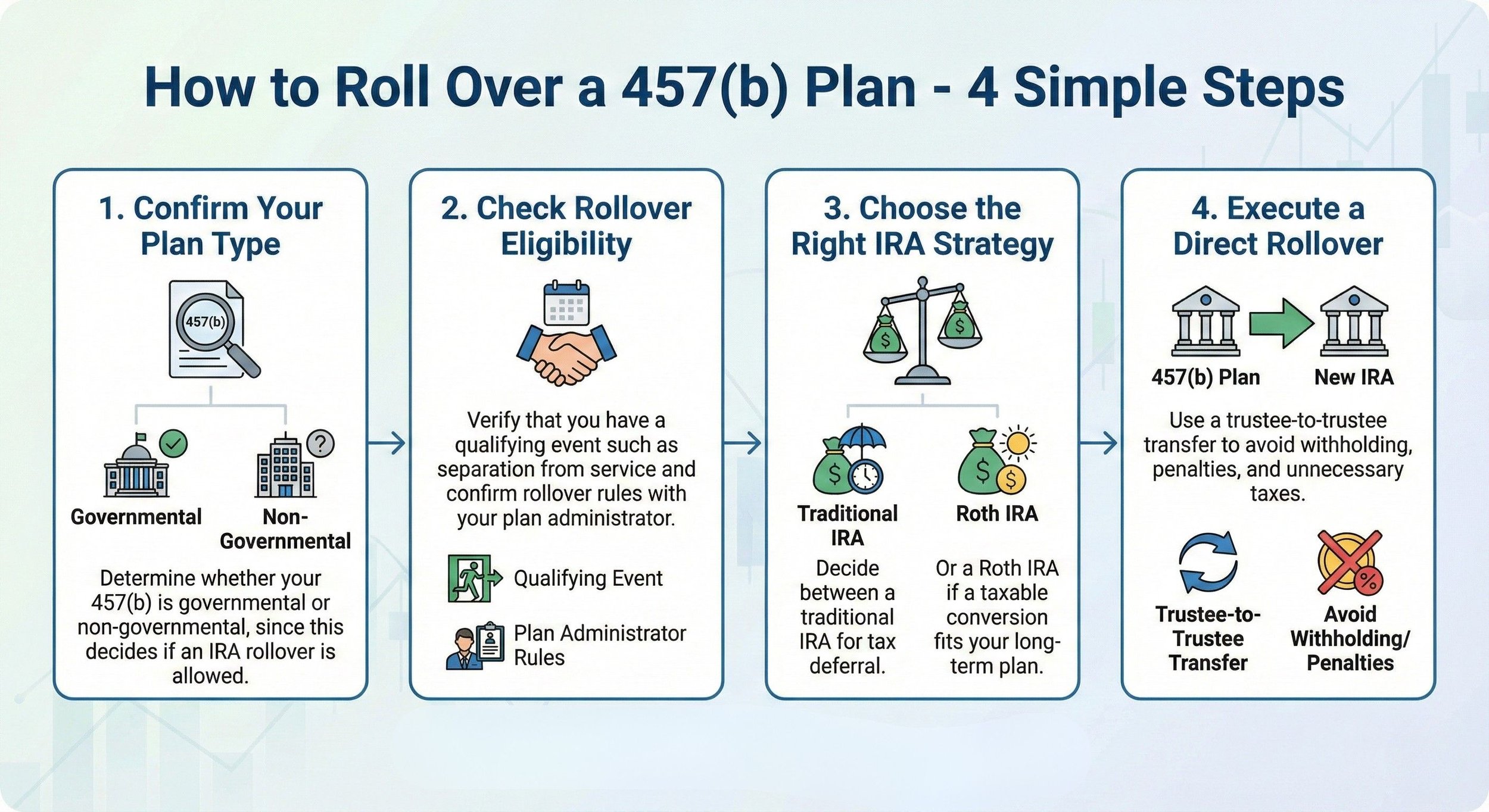
Understanding the Two Types of 457(b) Plans
Not all 457(b) plans are treated the same under IRS rules. The first and most important step is identifying whether your plan is governmental or non-governmental.
Governmental 457(b) Plans
Governmental 457(b) plans are offered by state and local governments and certain public entities. These are the most flexible type of 457 plan when it comes to rollovers.
In most cases, a governmental 457(b) can be rolled over to:
A traditional IRA
A Roth IRA
Another employer retirement plan, such as a 401(k) or 403(b)
If you move funds from a governmental 457(b) directly into a traditional IRA, the rollover is generally not taxable. The money keeps its tax-deferred status, and no taxes are due at the time of the transfer.
If you roll a governmental 457(b) into a Roth IRA, the rollover becomes a Roth conversion. That means the full amount converted is added to your taxable income for that year and taxed at your ordinary income tax rates.
Non-Governmental 457(b) Plans
Non-governmental 457(b) plans are typically offered by tax-exempt organizations such as hospitals, private universities, and charities. These plans operate under much stricter rules.
In most cases, non-governmental 457(b) plans cannot be rolled over into an IRA at all. The IRS generally only allows these plans to be transferred to another non-governmental 457(b) plan sponsored by a similar employer.
Because these plans remain legally tied to the employer until distribution, they do not qualify for IRA rollovers in the same way governmental plans do. Attempting to move a non-governmental 457(b) into an IRA can result in a taxable distribution.
When a 457(b) Rollover Is Allowed
Even if your plan is eligible for a rollover, you usually cannot move the money whenever you want. Most 457(b) plans require a qualifying or triggering event before distributions and rollovers are allowed.
Common Triggering Events
Typical triggering events include:
Separation from service with the employer
Retirement
Disability
Plan termination
Death of the participant
If you are still employed with the organization that sponsors the plan, rollovers are often not permitted. Some plans may allow in-service distributions under limited circumstances, but this is the exception rather than the rule.
Always check your plan’s summary plan description or speak directly with the plan administrator to confirm eligibility.
How to Roll Over a 457(b) Without Triggering Taxes
The method you use to move the money is just as important as the type of plan you have.
Direct Trustee-to-Trustee Transfer
The safest and cleanest way to roll over a 457(b) is through a direct trustee-to-trustee transfer. In this process, the funds are sent directly from your 457(b) plan administrator to your IRA provider.
When done correctly:
No federal tax withholding applies
The transfer is not reported as taxable income if moved to a traditional IRA
Your tax-deferred status is preserved
This approach avoids administrative mistakes and eliminates the risk of missing deadlines.
Indirect Rollover Risks
An indirect rollover occurs when the plan sends the money to you first and you then deposit it into an IRA yourself.
This method creates several problems:
The plan must withhold 20 percent for federal taxes
You generally have 60 days to deposit the full amount into an IRA
You must replace the withheld 20 percent out of pocket to avoid taxes on that portion
If you fail to deposit the full amount within 60 days, the shortfall is treated as a taxable distribution. Depending on your age and account type, penalties may also apply.
For most people, indirect rollovers create unnecessary risk and should be avoided whenever possible.
Rolling a 457(b) Into a Roth IRA
Rolling over a governmental 457(b) into a Roth IRA can be a strategic move, but it comes with an immediate tax cost.
How Roth Conversions Are Taxed
When you convert pre-tax 457(b) funds into a Roth IRA:
The converted amount is treated as ordinary income in that year
Federal and state income taxes apply
No early withdrawal penalty applies to the conversion itself
This can push you into a higher tax bracket if the conversion amount is large. Many people choose to convert in stages over multiple years to manage tax exposure.
When a Roth Conversion Makes Sense
A Roth rollover may make sense if:
You expect higher tax rates in retirement
You want tax-free growth and withdrawals later
You have low taxable income in the year of conversion
You do not plan to access the funds for several years
Because Roth conversions are irreversible, careful tax planning is essential.
Early Withdrawal Rules: 457(b) vs IRA
One of the most overlooked differences between a 457(b) and an IRA is how early withdrawals are treated.
Special Early Withdrawal Rule for Governmental 457(b) Plans
Governmental 457(b) plans have a unique advantage. Distributions taken after separation from service are not subject to the 10 percent early withdrawal penalty, even if you are under age 59½.
You still owe ordinary income taxes, but the penalty is waived.
What Changes After a Rollover to an IRA
Once funds are rolled into an IRA:
The special 457(b) early withdrawal exemption is lost
IRA early withdrawal rules apply
Withdrawals before age 59½ may be subject to a 10 percent penalty unless an exception applies
If you expect to access funds before age 59½, keeping money in a governmental 457(b) rather than rolling it into an IRA may provide more flexibility.
Required Minimum Distributions After a Rollover
Required minimum distribution rules also change depending on where the money is held.
457(b) plans generally require distributions to begin at age 73, unless you are still working for the employer that sponsors the plan.
Once funds are rolled into an IRA:
Required minimum distributions follow standard IRA rules
You cannot delay distributions by continuing to work
Roth IRAs have no required minimum distributions during your lifetime
This difference can affect long-term tax planning and cash flow in retirement.
Investment and Control Considerations
Beyond taxes and penalties, many people roll over a 457(b) to gain more investment flexibility.
Why Some People Prefer IRAs
IRAs often offer:
A broader range of investment options
Lower fees than employer plans
Easier account consolidation
More control over asset allocation
For investors who want customization and simplicity, an IRA rollover can be appealing.
Why Keeping a 457(b) Can Still Make Sense
In some cases, leaving funds in a 457(b) may be the better choice, especially if:
You may need early access before age 59½
The plan has strong investment options and low fees
You want creditor protections specific to the plan
You are not yet eligible for a rollover
How to Confirm What You Can Do
Because 457(b) rules vary by plan, the final authority is always your specific plan document.
Before initiating any rollover:
Confirm whether your plan is governmental or non-governmental
Ask what triggering events qualify for distributions
Verify whether direct rollovers are supported
Review tax consequences with a qualified tax professional
A short conversation with your plan administrator can prevent costly mistakes.
Final Thoughts on Rolling Over a 457(b) Plan
Rolling over a 457(b) plan to an IRA can be a powerful financial move, but only when done correctly. Governmental 457(b) plans are generally eligible for IRA rollovers, while non-governmental plans usually are not. Choosing a direct trustee-to-trustee transfer is the best way to avoid taxes and withholding, and understanding how early withdrawal rules change after a rollover is critical.
Not sure whether your 457(b) can be rolled into an IRA or how to do it without triggering unnecessary taxes? Schedule a consultation with ZAG Consult Group to review your plan type, rollover options, and tax implications so you can move forward with clarity and confidence.
